2002-04 CARBOY - Deeper and Deeper into Nakai & Porsche Tuning
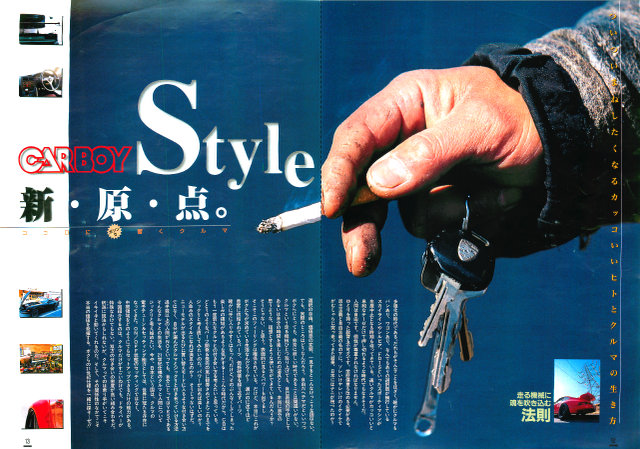
The cover photo “hand model” is Nakai-kun himself.
His hands are covered in scars from working on cars, holding a short Hope cigarette and a keyholder…
Sorry—we’re publishing this purely out of personal satisfaction. (laughs)
Deeper and Deeper into Nakai & Porsche Tuning
His current pride and joy—a bright red, glossy-painted machine—has become a wildly lively, unpredictable “SPL wild horse.”
“We’ve built a seriously cool car!”
Nakai sounded genuinely excited over the phone.
I already knew he had moved from AE86s to Porsches and had been applying his own Nakai-style modifications.
But seeing the car in person during this interview made it unmistakably clear:
This is Nakai-style car building.
It feels exactly like the days when he used to fully modify KP61s and AE86s.
A cheap base car.
A simple mechanical layout that even amateurs can fully understand and modify.
And the thrill of doing tuning no one else had attempted before.
All of that combined pulled Nakai deeper and deeper into Porsche modification.
A car that can be driven hard on the street, then taken straight to the circuit without hesitation.
In fact, it has the potential to outrun cars specifically tuned for the circuit.
That’s what makes it so remarkable.
In the early days, when he brought a heavily cambered Porsche to the circuit, the surrounding drivers looked at him like he was some kind of outsider.
Well… that was expected.
Porsche enthusiasts have their own “common sense.”
Even AE86 drivers, when they first saw Nakai’s AE86, must have thought:
“Is this even allowed?”
“Compared to my AE86 days, I’ve matured a bit.
So instead of zip ties, I now use proper metal latch straps for the bumpers.”
Nakai said this proudly. And indeed, the bumpers were hung using metal latch-style fasteners. Though honestly… the “hanging bumper” concept itself hasn’t changed much since his AE86 days.
The Suspension That Defies Logic
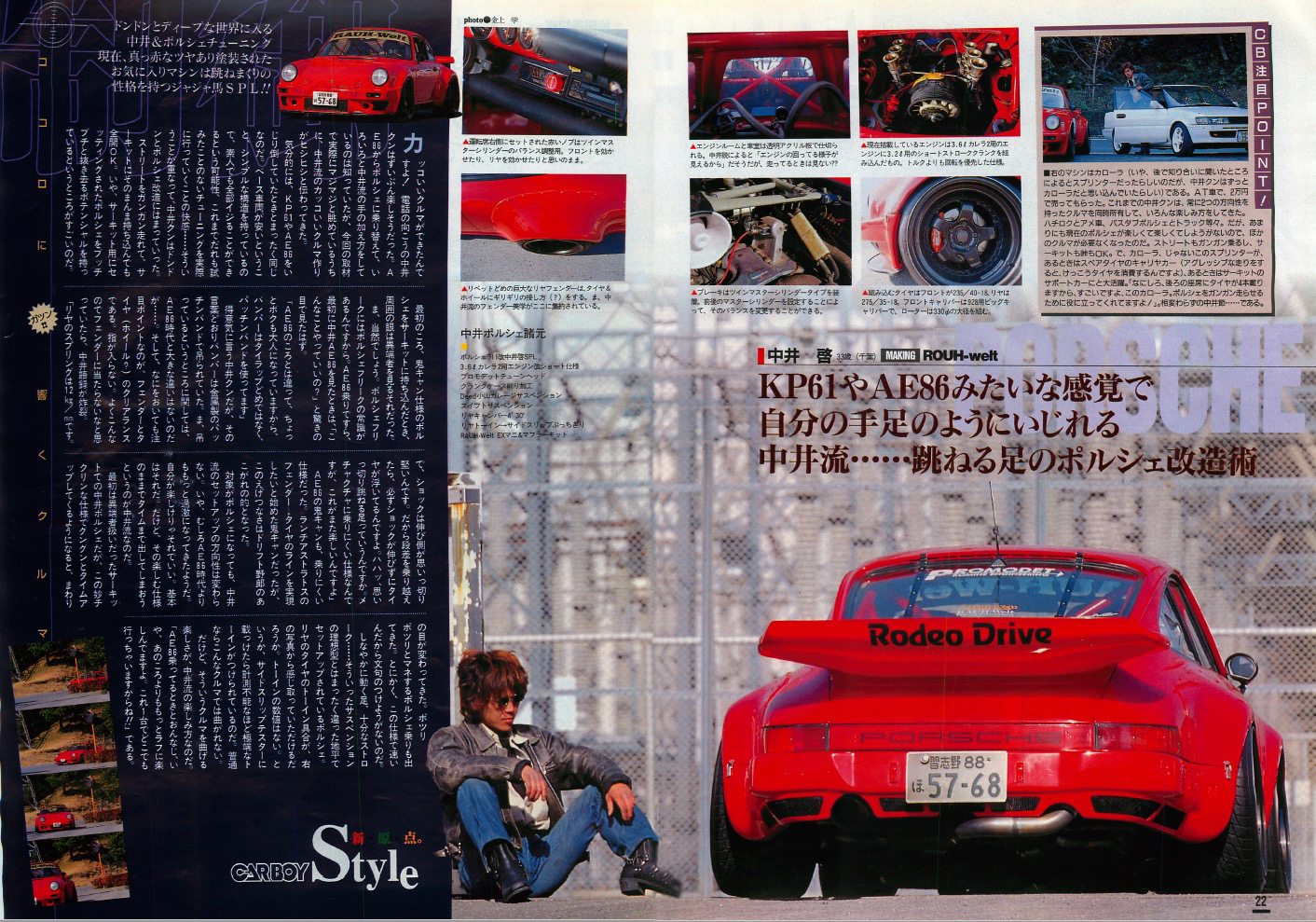
One of the biggest visual highlights is the clearance between the fender and the tire (or wheel). You can’t even fit a finger in there.
Naturally, the question arises:
“How does this not rub?”
Then comes Nakai’s explanation:
“The rear springs are 12 kg/mm.
The shock absorbers are extremely stiff on rebound.
So when you go over a bump, the shock doesn’t extend properly and the tire actually lifts off the ground.”
“It’s basically a ‘car that bounces like crazy.’”
“It’s honestly hard to drive… but that’s exactly what makes it fun.”
His AE86 setups were also notoriously difficult to drive. Originally inspired by recreating the wheel fitment lines of a Lancia Stratos, his extreme camber setups became a dream among drift enthusiasts.
Even after switching to Porsche, his philosophy hasn’t changed.
If anything, it has become even more extreme than during the AE86 era.
“If It’s Fun, That’s Enough”
At its core, that’s the philosophy. But Nakai takes it further: He tries to make a car that is fun to drive and still capable of posting fast lap times.
At first, his circuit-built Porsche was treated as an oddity. But once it started improving lap times rapidly with its unusual setup, opinions began to change. Soon, other Porsche owners started copying it. Because in the end—if it’s fast, it’s hard to argue against.
A suspension setup that is completely different from the traditional ideal of smooth articulation and long travel. This Porsche is tuned in a completely different direction.
From the photos, you may notice the rear toe-in angle. There is no exact number recorded. In fact, if placed on a side slip tester, the toe-in would likely be so extreme that it becomes unmeasurable. Normally, a car like this shouldn’t be able to corner properly. But the joy comes precisely from making such a car turn.
“It’s just like when I was driving AE86s—actually, even more relaxed than back then.
I can go anywhere with this car.”
Box Section (Sidebar)
The car on the right is a Corolla
(or rather, later someone told him it was actually a Sprinter—but Nakai always thought it was a Corolla).
It’s an automatic car bought for 20,000 yen.
Throughout his life, Nakai has always owned two contrasting cars at the same time:
- AE86 + American car
- bathtub Porsche + truck
and so on.
But now, his current Porsche is so enjoyable that he no longer needs anything else. Street driving, circuit driving, mountain passes—it does it all.
This “Corolla” (actually Sprinter) serves as:
- a spare tire carrier (because aggressive driving consumes tires quickly)
- a circuit support vehicle
“It can carry four tires in the back seat alone. Amazing, right?
This Corolla is what keeps the Porsche running hard!”
Same old Nakai style.
Photo Captions
● Caption 1
The engine currently installed is based on a Carrera 2 3.6 engine,
combined with a short-stroke crank from a 3.2 engine.
A setup that prioritizes revs over torque.
● Caption 2
Front tires: 235/40R18
Rear tires: 275/35R18
Front brakes use 928 big calipers with large 330 mm rotors.
● Caption 3
The engine bay and cabin are separated by a clear acrylic panel.
According to Nakai:
“So you can see the engine running.”
Though obviously, not while driving…
● Caption 4
Twin master cylinder brake system installed.
Allows front/rear brake balance adjustment.
● Caption 5
The red knob on the right side of the driver controls brake balance.
Adjust front or rear braking force freely.
● Caption 6
Massive riveted rear fenders sit almost touching the wheels.
This is the essence of Nakai-style fender aesthetics.
Spec List — Porsche 911 Nakai Kei SPL
- 3.6 Carrera 2 engine (short-stroke modified)
- Promodet tuned cylinder head
- Machined crankcase
- Deed / Koyama Garage suspension
- Swift springs
- Rear camber: 4°30'
- Rear toe: extreme (beyond side slip measurement range)
- RAUH-Welt EX manifold & exhaust kit