1998-08 CARBOY - Akira Nakai's Porsche Carrera Project - Suspension Evolution
Not just the exterior, but also the engine, suspension, and everything else follow the Nakai style.
This is where the origins of today’s RAUH-Welt philosophy can be found… (lol)
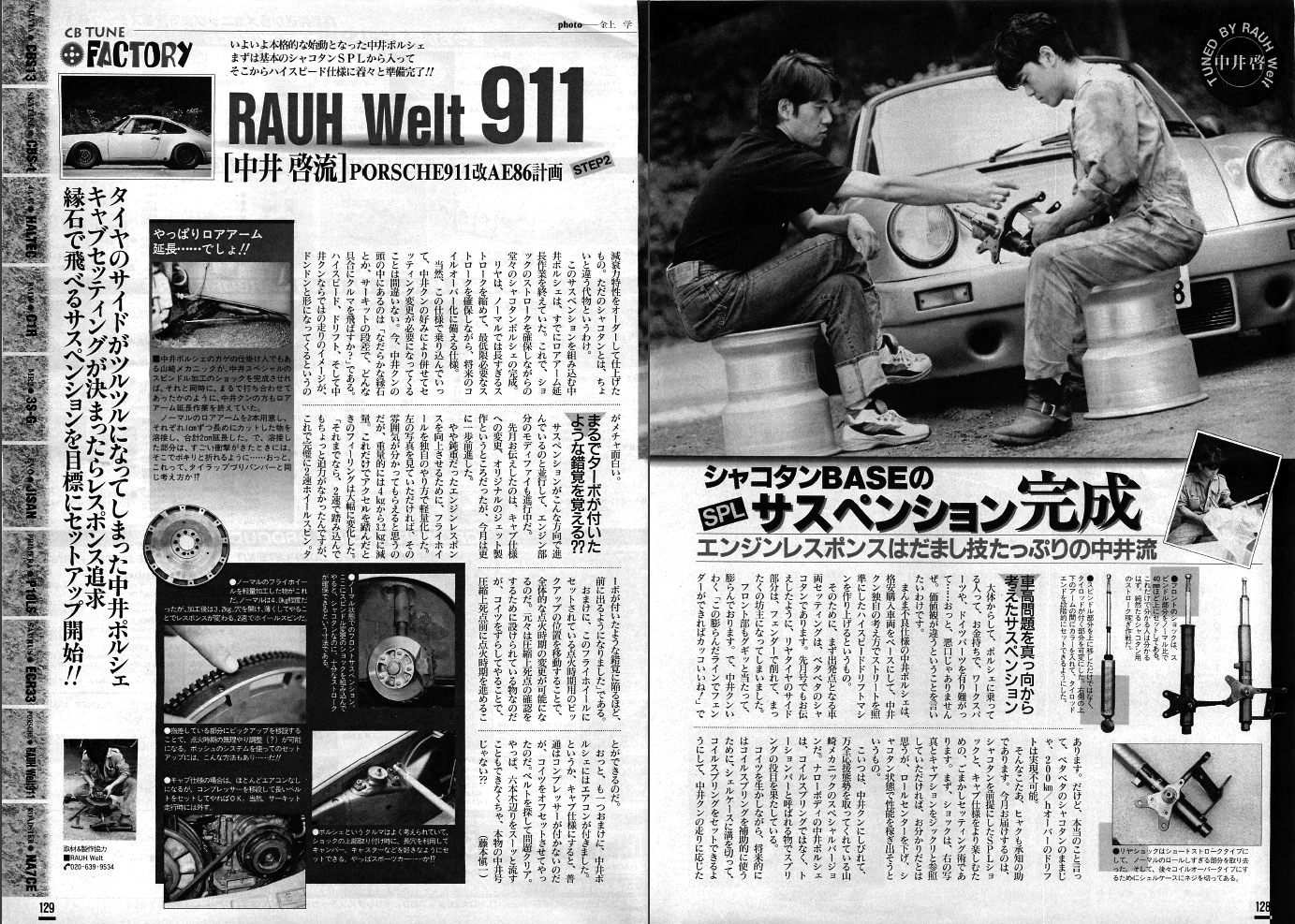
The Nakai Porsche has finally begun full-scale development.
Starting with the basic slammed “shakotan SPL” setup, it is now steadily being prepared for a high-speed specification.
Suspension built by directly confronting ride-height issues
Generally speaking, Porsche owners tend to be wealthy people who value factory or German performance parts…
But no offense intended — it’s simply a difference in values.
Nakai’s “delinquent-spec” Porsche is built on a low-cost base car,
shaped by his own ideas into a street-oriented high-speed drift machine.
The starting point of the setup is extreme lowering.
As mentioned in the previous issue, the rear tire sidewalls were already being shaved by the
fenders until they became completely bald.
At the front, the tires were also making heavy contact and bulging outward.
Nakai’s comment on that:
“If the fender followed that bulging line, it would actually look pretty good.”
However, in reality, a fully slammed setup alone cannot achieve stable drift at speeds over 200 km/h.
That much is obvious to him.
This month’s theme: SPL shocks + “workaround tuning”
This issue focuses on:
- Special shocks designed for a slammed setup
- And tuning tricks to make carb setup more usable and enjoyable
The shock setup is based on lowering the roll center and extracting performance even in a heavily lowered state.
This is a special version developed by mechanic Yamazaki, who strongly supports Nakai’s project.
The narrow-body Porsche uses torsion bars instead of conventional coil springs.
These are used as the primary spring medium.
Building on that system, the shocks are further refined so that coil springs can be added in the future as assistance.
Grooves are cut into the shock body to allow coil spring mounting, and damping characteristics
are custom-ordered to match Nakai’s driving style.
This is not just a simple slammed setup.
Suspension installation and chassis work
The suspension was installed after the front lower arms had already been extended.
This allowed sufficient suspension stroke while maintaining a proper slammed stance.
At the rear:
- Excessively long stock stroke was shortened
- Minimum required stroke was retained
- Prepared for future coilover conversion
Naturally, further fine-tuning based on actual driving feedback is expected.
At this point, Nakai is thinking about:
“How the car behaves over curbs, track edges, and uneven surfaces when pushed at speed.”
The image of high-speed drifting unique to him is gradually taking shape.
It almost feels like the car has gained a turbocharger.
Engine development continues in parallel
While suspension development progresses, engine modifications are also moving forward.
Last month covered:
- Carb conversion
- Handmade jet fabrication
This month, things have advanced further.
Flywheel weight reduction
To improve previously sluggish throttle response, the flywheel was modified using Nakai’s own method.
- Stock weight: 4.0 kg
- Modified weight: 3.2 kg
This alone dramatically changed throttle feel.
According to Nakai:
“Before, even full throttle in 2nd gear didn’t feel that strong.
Now it wheelspins instantly in 2nd — it feels like the engine gained a turbo.”
Ignition timing adjustment via pickup relocation
By moving the ignition pickup position mounted on the flywheel system, overall ignition timing can be adjusted.
Originally, this component is used to detect top dead center (TDC).
By shifting its position, ignition can be advanced before TDC.
One more addition: air conditioning retained
The car even retains air conditioning.
Normally, carb conversions eliminate the compressor,
but in this case it was offset and re-mounted.
A longer belt solves the routing issue.
After all, a proper “Nakai machine” should still be able to cruise smoothly through areas like Roppongi.
Side note (mechanic collaboration)
The mechanic behind the suspension work, Yamazaki, completed the special spindle-modified shocks.
At the same time, almost in parallel, Nakai finished extending the lower arms.
- Stock lower arms were duplicated
- Each was extended by 10 mm
- Total extension: 20 mm
The welded section is designed so that in extreme load situations it would fail at the joint in a controlled way…
similar in concept to a zip-tie mounted bumper setup.
Photo captions
1
The front shocks have been modified so the spindle section sits roughly 40 mm higher than stock.
For those who understand, this is a pure stroke-preservation trick for a lowered setup.
2
Not only the spindle position was changed — the tie rod mounting was made adjustable.
A collar was inserted between the upper and lower arms, allowing stepwise adjustment of tie rod end position.
3
Rear shocks are shortened stroke types, removing excessive body roll behavior.
The shock body is threaded in preparation for future coilover conversion.
4
Standard front suspension layout.
With the modified spindle shocks installed, even a slammed car retains proper suspension travel.
5
The Porsche chassis allows camber and caster adjustment using slotted mounting points at the top of the shock.
As expected from a sports car… or maybe more than expected.
6
The flywheel after weight reduction.
Stock was around 4.0 kg, now reduced to 3.2 kg.
Lightening through drilling and machining improves response — and enables instant 2nd gear wheelspin.
7
Relocating the pickup position allows forced ignition timing adjustment.
An unconventional but effective way to tune a Bosch ignition system.
8
With carb setups, air conditioning is usually removed.
Here, the compressor is relocated and driven via a longer belt.
Of course, it is removed during track use.