1998-07 CARBOY - Akira Nakai's Porsche Carrera AE86-style Project
Not just the exterior, but also the engine, suspension, and everything else follow the Nakai style.
This is where the origins of today’s RAUH-Welt philosophy can be found… (lol)
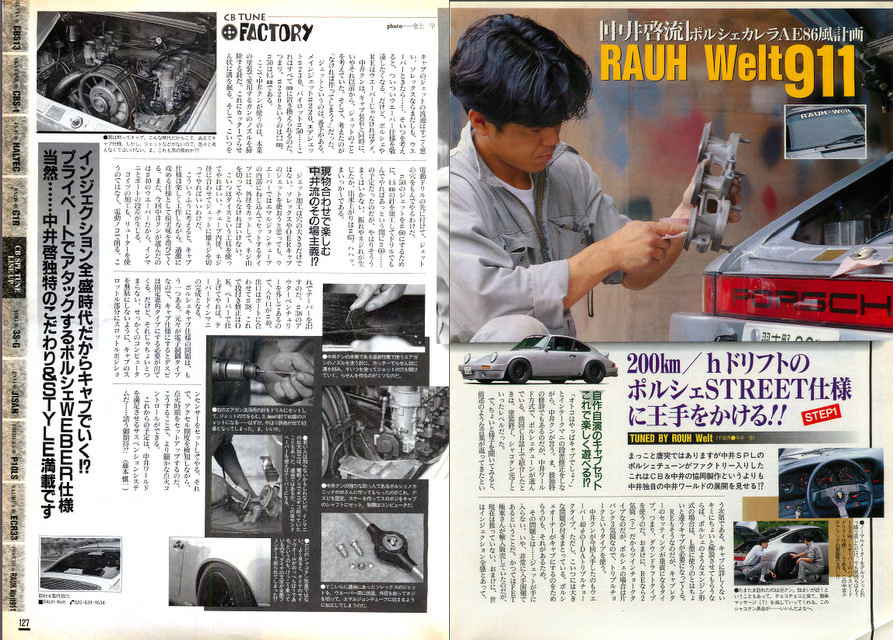
Carburetors in the age of fuel injection!?
A private attack-spec Porsche in Weber configuration.
Naturally, it’s packed with Akira Nakai’s unmistakable obsession and style.
DIY carb setup — can this really be fun?
“Men should run carbs, after all!” Nakai says while filing down a step in the intake manifold.
It’s one of his signature phrases, but the Porsche build is moving forward in full Nakai-world fashion.
When it was last featured in CB magazine, it had only reached the point of fresh paint and a completed slammed stance.
When asked for an update, the answer came back like this.
For those unfamiliar with carburetors, a quick explanation:
Engines like Porsche’s require a different carb setup compared to something like an L-series engine.
The same goes for rotary engines (RE), where the carb setup is vertical — meaning a down-draft type is used.
Rotaries typically run twin-choke carbs, but a Porsche flat-six needs a triple-choke setup, since each bank
effectively requires its own feed.
Weber 40φ IDA triple-choke setup
What Nakai picked up this time is a Weber 40φ IDA triple-choke carb.
But there’s a major issue that comes with it —
and it’s the same reason many Porsche owners hesitate to go down the carb route.
The problem: jets are nearly impossible to find
They’re extremely hard to get hold of.
They used to be imported and distributed by FET Kyokuto, but that’s no longer the case.
And in a fuel-injection-dominated world, carb jet availability has become very poor.
Solex is still manageable, but Weber is another story entirely — enough to make most people think twice.
Still, Porsche and rotary engines really only work properly on Weber systems.
Nakai had already been thinking about jets when he chose the carb setup — or more accurately, even before that.
His conclusion: “If it doesn’t exist, I’ll make it.”
Jets are defined by size:
- Main jet: 220φ
- Air jet: 230φ
- Pilot jet: 50φ
These correspond directly to millimeters:
- 220φ = 2.2 mm
- 50φ = 0.5 mm
What he uses here is a cleaning needle from a paint spray gun nozzle — a tool from his day job.
He cuts spiral grooves into it with a blade, then mounts it on a power drill and uses it to rework the jet orifice.
The idea was simple:
Modify a 0.6 mm needle and quickly turn a 50φ jet into a 60φ one.
Of course, it doesn’t go that cleanly.
Between runout and slight misalignment, the final result comes out at 63φ.
“Well… close enough,” he shrugs.
Real-world fitting — Nakai’s “make it fit” philosophy
Jet work isn’t just about drilling holes.
Even when using Solex or OER jets, Weber setups require a different mounting style — where the jet screws into the emulsion tube.
That means:
- The outer diameter must be cut down
- Threads must be cut with a die
A die tool is used to cut the male threads to match the tube’s inner diameter.
Seen this way, carb tuning becomes a hands-on fabrication process — part engineering, part improvisation, and fully committed.
Intake manifold matching
With 40φ Weber carbs, a step difference appears between the intake manifold and the ports.
Instead of a die grinder, he uses an electric saw to shape it.
That’s how the taper is formed.
With the 38φ outer venturi removed:
- Inlet: 40φ
- Outlet: matched to 38φ port
This removes the step completely.
Final finishing is done by hand with sandpaper, resulting in a properly tapered intake manifold.
One more issue with carb conversion
Because the original engine is electronically controlled, switching to carbs normally means:
- Converting to a fixed-advance distributor
But that would be too simple.
So instead of throwing the ECU away, a throttle position sensor (TPS) is added to the carb linkage.
This allows the system to:
- Detect throttle input
- Adjust ignition timing accordingly
Result: far more precise ignition control than a basic carb swap.
What’s next
Next up is a suspension system built to satisfy the Nakai World philosophy…
Stay tuned.
Photo captions
1
The stock gauge cluster has simply been flipped upside down.
But mentally, it’s already a 200 km/h+ high-speed drift setup. The used steering wheel also has a nice, raw character.
2
A friend known as “Mujou” drops by — he lives nearby and often stops in to give the car a quick “massage.”
And honestly, this slammed stance just works.
3
Men run carbs.
In this era, choosing carbs on purpose is almost a statement. But without proper jets, you end up figuring
everything out yourself.
4
A paint spray gun cleaning needle is modified with spiral grooves and used to rework jet holes.
That spiral cut is the key detail.
5
A Porsche mechanic (Mr. M) helps out: the distributor is fixed, and a throttle position sensor is mounted
via a bracket onto the carb shaft.
Ignition control is handled by the ECU.
6
Random Solex jets are adapted for Weber use — outer diameter reduced, threads cut, and reshaped to fit the emulsion tube.
7
A drill-mounted cleaning needle is used to rework jet sizing.
Target was 60, but the result ended up at 63 due to tolerances — close enough.
8
Intake manifold enlargement used to be done with an electric saw in the old days.
Rough shaping, then finished properly with sandpaper to form a taper.
9
This isn’t just a slammed photo.
If you look closely, the tire sidewalls are completely smooth — all lettering has been worn
off by the fenders from repeated hard driving.