1997-04 CARBOY - Feature on Akira Nakai
Reading it again now, I find myself thinking—with some self-satisfaction—that it came remarkably close to capturing the essence and presence of Akira Nakai.
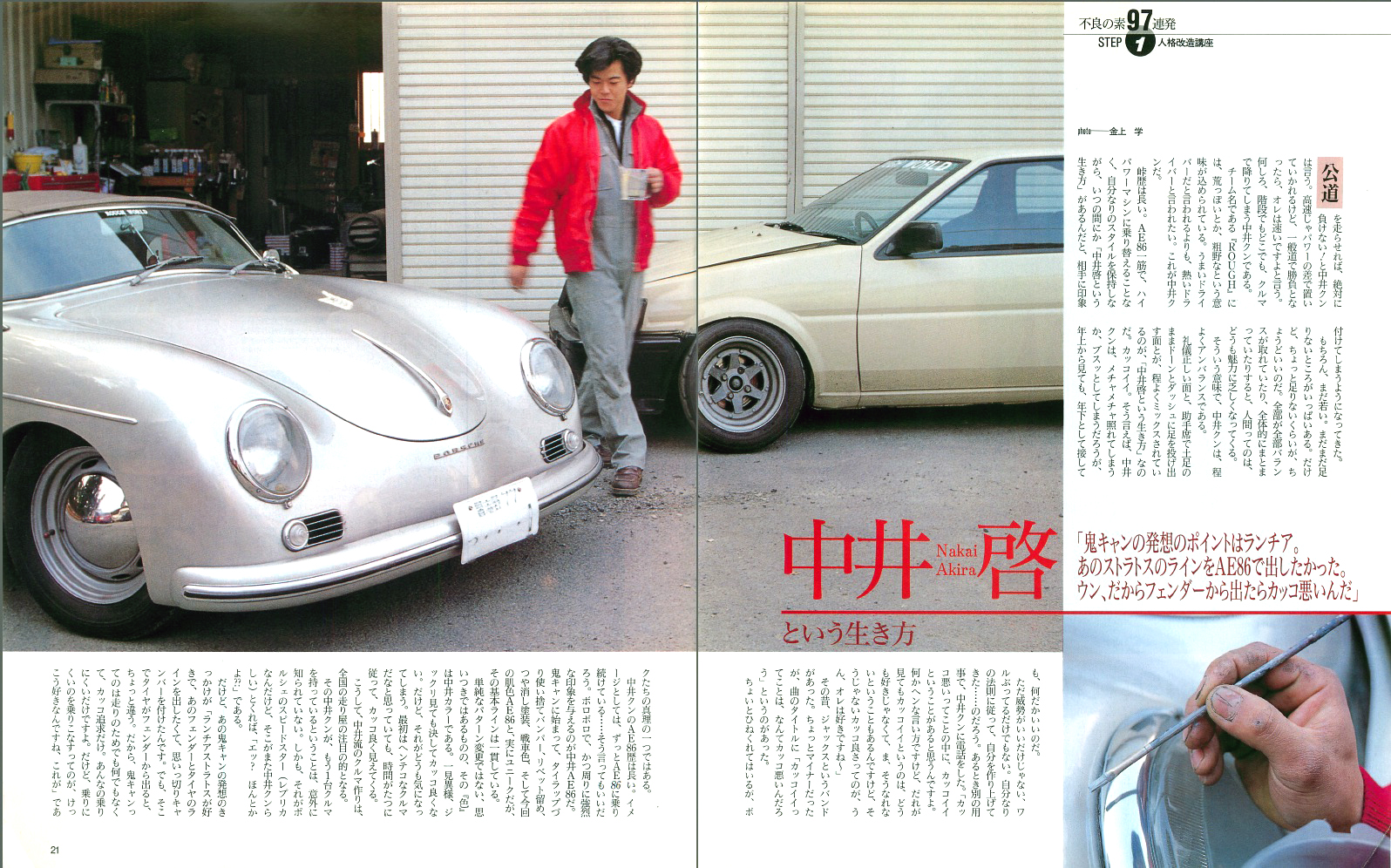
Nakai says:
“If we’re driving on public roads, I absolutely won’t lose.”
On the highway, sure, more powerful cars will pull away from him. But on regular roads, he insists he’s faster than anyone. After all, this is the same Nakai who would drive his car down staircases if he felt like it.
The name of his team, ROUGH, was chosen to convey meanings like rugged, rough around the edges, and uncivilized. Rather than being called a skilled driver, he’d rather be called a passionate one. That’s who Nakai is.
His history on mountain roads is long. He stayed loyal to the Toyota AE86, never moving on to higher-powered machines. While maintaining his own style, he gradually reached the point where people began to recognize that there was such a thing as “the Nakai way of life.” Of course, he was still young. There were plenty of things he lacked. But being slightly incomplete is actually ideal. When everything is perfectly balanced and neatly put together, people tend to lose their appeal.
In that sense, Nakai was perfectly unbalanced. His polite side and his habit of casually throwing his dirty boots onto the dashboard from the passenger seat blended together in just the right proportion.
That mix was what defined “the way Akira Nakai lived.”
If you told him he was cool, he’d either become incredibly embarrassed or sulk. But whether viewed by someone older or younger, there was simply something likable about him.
He wasn’t just loud and aggressive, nor was he merely pretending to be a bad boy. He had built himself according to his own personal rules.
The Coolness Inside Being Uncool
One day, during a phone conversation unrelated to cars, Nakai said:
“I think there’s something cool hidden inside things that aren’t cool. It’s a strange way of putting it, but I’ve never really liked things that everyone agrees are cool. Maybe that’s because I can’t become that kind of person myself. But that other kind of coolness—that’s what I like.”
Years ago there was a band called The Jacks. They were somewhat obscure, but one of their song titles was:
“How uncool it is to be cool.”
Twisted, perhaps—but it’s one of the truths we believe in.
The AE86 Years
Nakai’s AE86 history stretches back many years. In fact, you could say he simply never stopped driving one.
His battered AE86 left a powerful impression wherever it went.
- Extreme negative camber
- Zip-tied disposable bumpers
- Riveted bodywork
- Matte paint
- Military-green paint
- And eventually, a skin-colored AE86
All of it was unique, yet there was a consistency running through everything.
These weren’t simple cosmetic changes. The ideas often came on impulse, but the “color” of those ideas was unmistakably Nakai’s own. At first glance the cars looked strange. Even after careful examination, they weren’t conventionally attractive. And yet they stuck in your mind.
You might initially think:
“What a weird car.”
But over time, somehow, it starts looking cool. That was how Nakai’s approach to building cars became a source of fascination for street racers across Japan.
The Porsche Speedster
What many people didn’t know was that Nakai also owned another car.
A Porsche Speedster.
A replica, of course—which somehow made it even more Nakai-like.
People would react:
“Wait, seriously?”
But when you understand where his famous extreme camber style came from, it starts to make sense.
Nakai explained:
“I loved the Lancia Stratos. I wanted to recreate that relationship between the fenders and the tires, so I gave it ridiculous camber. But if the tire sticks out past the fender, it doesn’t look right. So the extreme camber wasn’t about performance at all—it was purely about appearance. They’re terrible to drive. But I kind of enjoy mastering something that’s difficult.”
He liked foreign cars. Or rather, he liked anything that fit his personal tastes.
Japanese or foreign—it didn’t matter. This was the same Nakai who:
- Drove a tiny kei car to Roppongi wearing coveralls and tried to pick up women.
- Would drive alone endlessly without a destination.
- Drove a Porsche to Kusatsu for a ski trip without snow chains.
His aesthetic sense often looked bizarre from the perspective of ordinary people. But inside Nakai’s mind, everything followed a clear logic. Talking about the Speedster, he said:
This body has the most deeply tucked-in wheels in the world. That’s what I love about it. The price? One million yen. It’s a replica, after all.
But that’s kind of me, isn’t it?
It was built by a German company called Intermeccanica. The quality is actually really good. I searched for ages before finally finding this used one.
The convertible top frame looked ugly because it sat too high, so he cut it down himself. As a result, with the roof up, the interior became incredibly cramped. But that was fine. The engine would be heavily modified. And he’d drive it everywhere. Somehow, that style of ownership suited him perfectly.
A Dirty Car, A Refined Understanding
As for the AE86…
To be blunt, it was filthy.
- Engine oil leaked everywhere.
- The carburetor jet cover was missing.
- Oil looked ready to splash onto the timing belt.
- The wiring was a mess.
The engine bay looked like something that shouldn’t even exist. Yet Nakai would say:
“This is good enough.”
After eight years of driving an AE86, blowing engines, crashing cars, and abusing them relentlessly, he’d learned what really mattered. There were parts you absolutely had to maintain.
And parts you could completely ignore. That distinction was what he understood.
So while his AE86 looked sloppy, it reliably supported his rough, aggressive driving. Anyone who watched him drive on mountain roads would say:
“It’s hard to tell because he’s driving an AE86, but Nakai is unbelievably skilled.”
Yet Nakai never considered himself a great driver. Nor did he particularly enjoy hearing that. What he wanted people to say was:
“That guy drives with passion.”
That, he said, made him happiest.
The Spirit of Tuning
The tuning world was changing rapidly. Years earlier, people who modified cars and drove flat-out were viewed as street racers and delinquents. They looked intimidating. You admired them from a distance. You didn’t easily approach them. But then tuning became mainstream. Everyone was tuning cars. Nakai hated that mentality. Not because he wanted tuning to remain exclusive, but because, to him, the essence had always been different. His attitude was:
I do things my way.
I refuse to be like everyone else.
I’m the fastest.
Why should anyone else understand what that means to me?
That was his philosophy. Maybe it was old-school. Maybe it wasn’t. But he wanted to remain a real person with conviction.
Too many modern tuning enthusiasts had horsepower and information, but lacked the courage and spirit that mattered when it came time to commit. There were exceptions, of course.
But far fewer than there should have been. Among those rare people who still carried that spirit, Nakai was one of them. Sometimes he was a boy. Sometimes surprisingly mature. Sometimes just an idiot having fun. But underneath it all there was an unmistakable authenticity about him. Perhaps that’s too much praise.
Step on the Accelerator
There are countless people who only look the part. Countless people who can talk endlessly. But there aren’t many who can truly attack the streets with commitment. If you’re spending all your time talking, step on the accelerator instead. That’s one thing I’d like beginners in tuning to understand.
Knowledge matters. Information matters. But beneath all of that lies a fundamental principle:
You have to be willing to step into dangerous territory.
That’s what separates tuning culture from every other automotive trend. It doesn’t matter how many speakers you install. Or how practical your vehicle is. If speed is what you’re pursuing, everything else becomes secondary.
Looking Ahead
I suspect Akira Nakai will continue changing throughout his life. He’ll dream up strange ideas. Take pleasure in them himself. And keep planting his foot firmly on the accelerator. That’s probably how it will be. And when I look at that Porsche, I can’t help feeling that it, too, has become infused with Nakai’s unmistakable character.
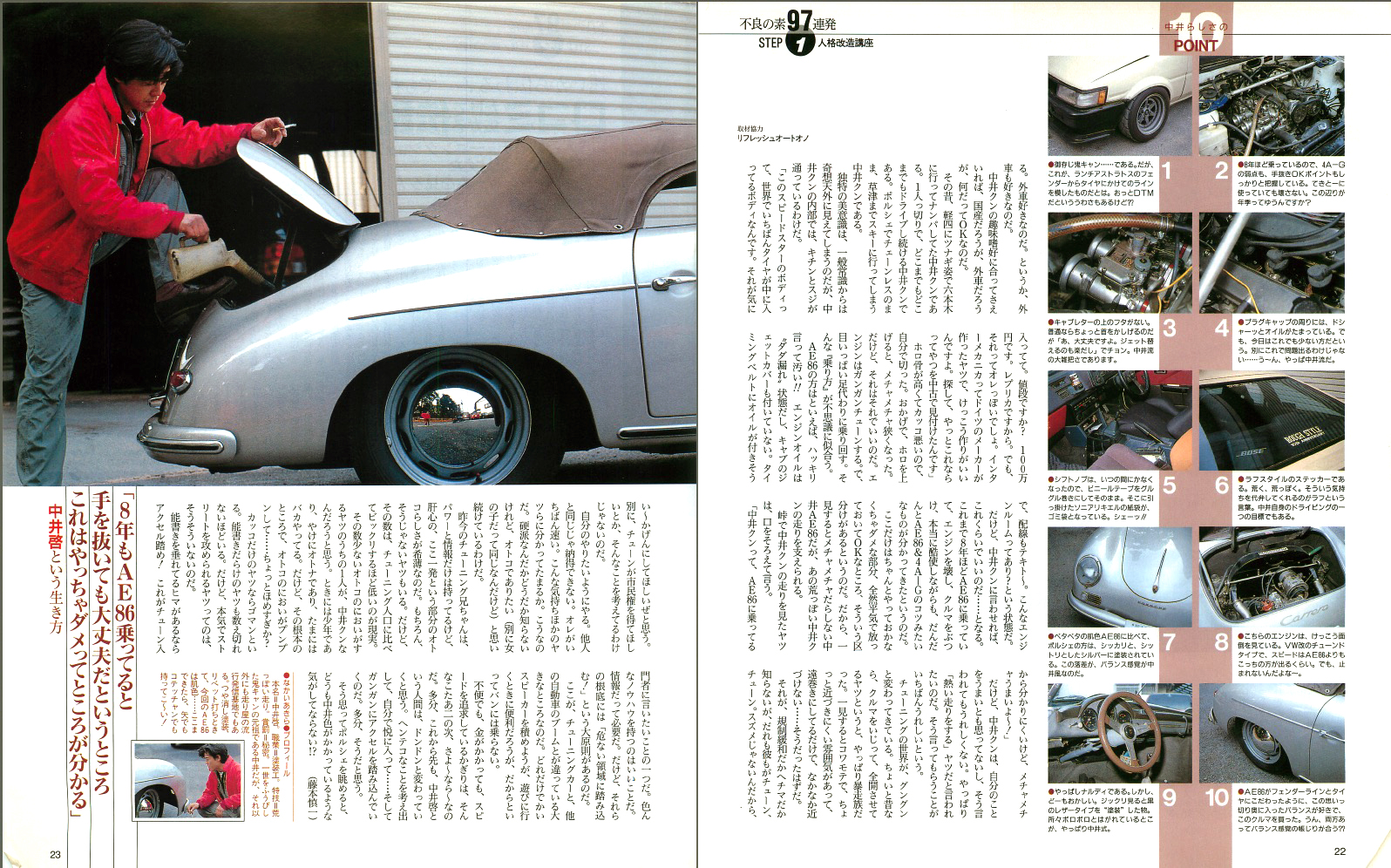
Photo 1
Everyone knows the infamous oni-camber setup… but the reasoning behind it is actually inspired by the line from the fender to the tire on the Lancia Stratos. Or so the rumor goes—it might even be related to DTM??
Photo 2
He has been driving this car for about 8 years, so he knows the weak points of the 4A-G engine as well as the areas where you can cut corners. Even when used roughly, it doesn’t break down. Maybe that’s what you call experience?
Photo 3
The carburetor is missing its top cover. Normally you’d raise an eyebrow, but he just says, “It’s fine—makes changing jets easier,” and that’s that. Typical Nakai-style roughness.
Photo 4
There’s a huge amount of oil pooled around the spark plug caps. But apparently, today is actually a “better” day. It doesn’t cause any problems anyway… yeah, definitely Nakai style.
Photo 5
The shift knob disappeared at some point, so it’s just been wrapped in vinyl tape. Hanging from it is a Sonia Rykiel paper bag being used as a trash bag. Sheesh!
Photo 6
This is a “ROUGH WORLD” sticker. Rough, raw, and aggressive—that’s what the word “ROUGH” represents. It’s also one of Nakai’s personal driving philosophies.
Photo 7
Compared to the heavily cambered skin-colored AE86, the Porsche is painted in a solid, smooth silver finish. This contrast is part of Nakai’s unique sense of balance.
Photo 8
This engine is actually pretty well maintained. It’s a modified VW-based tuned unit, and it’s said to be even faster than the AE86. But… it doesn’t stop very well.
Photo 9
A Nardi steering wheel—or so it seems. But something is odd: on closer inspection, it’s a black leather wheel that has been painted over. The paint peeling in places is very much Nakai-style.
Photo 10
Just like the AE86 focused on the relationship between the fender line and the tire, he liked the deeply tucked-in wheel setup of this car and decided to buy it. In a way, having both balances everything out.
Akira Nakai — Profile
| Item | Details |
|---|---|
| Real Name | Akira Nakai |
| Occupation | Painter / Bodywork Specialist |
| Special Skill | Rough Driving |
| Record | Secret |
Nakai became famous as the originator of the oni-camber (extreme camber) style, but he was also a trendsetter for Japan’s street-racing scene.
Matte paint. Riveted bodywork. And now a flesh-colored AE86. At this point, bring on whatever crazy idea comes next.
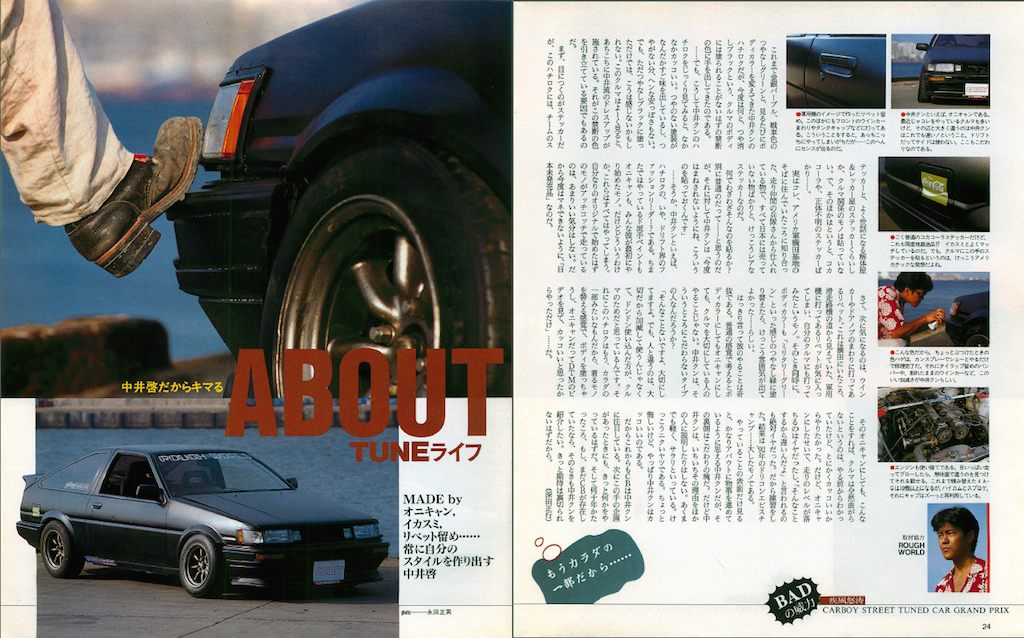
Looking Back from Today
Today, Nakai travels the world as a uniquely distinctive Porsche builder, creating custom-made machines one by one. His Nakai-style Porsche creations are admired internationally. In fact, while he is often considered an outsider in Japan, the global automotive community views his work as undeniably cool. When you think about it, how many Japanese builders have ever been embraced in quite this way? Rather than simply installing his own body kits, he works directly with owners, creating one-off cars through personal collaboration.
When I first started talking with Nakai, one thing that caught my attention was his hands. His gentle way of speaking didn’t match them at all. His fingers were rough, thick, and worn—the hands of a craftsman who had spent years doing bodywork and paint, but also the hands of a drifter determined to build the cars he loved. Once, for a CARBOY magazine feature, I took a close-up photograph of Nakai’s hands and used it as the entire title page.
It was a bold thing to do.
But there was a certain truth and conviction in those hands that justified it.